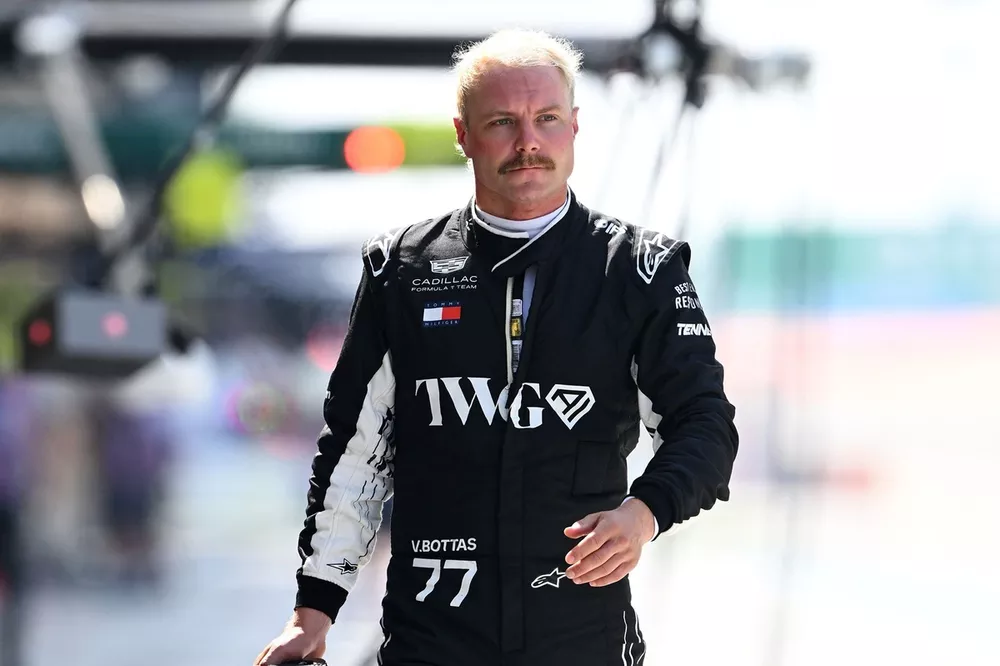
F1 Drive understands that valtteri Bottas has laid out his sharpest take yet on life inside Cadillac's Formula 1 project, describing what he calls a "steep progression" since the team's first shakedown and casting his return to the grid as the fresh chapter his career had been missing.
The Finn, who spent 2025 on the sidelines after leaving Sauber at the end of 2024, is now partnered with Sergio Perez at Cadillac in what is the first genuine new-team entry since Haas arrived in 2016. The novelty of the project, Bottas says, is half the appeal.
Where a veteran joining an established squad inherits someone else's processes, Bottas has been asked to help design them – from the steering wheel layout upwards. He paraphrases the experience as rare and, after a year away from the cockpit, genuinely energising. There is a point in every driver's career, he has suggested, when sitting inside a car someone else built is no longer enough, and being asked to draw the buttons himself is a different kind of challenge.
Bottas indicated that steering wheel ergonomics, switch configuration and even steering ratios have been areas where he and Perez have directly shaped the CA01. For a team with no historical DNA to protect, that driver input travels further than it would at Mercedes or Ferrari, where decades of engineering orthodoxy resist quick changes.
He has also argued that Cadillac's learning curve is genuinely steep in the engineering sense, not the rhetorical one. Bottas believes the car that ran at the first shakedown and the car that will line up for the Miami Grand Prix are meaningfully different machines, and that the speed of iteration inside the Andretti-led operation is among its strongest assets.
Mario Andretti has publicly set the target at top-ten finishes before the end of 2026, a benchmark that once would have sounded ambitious for a rookie team in a regulation-reset year. Bottas's framing suggests the internal target is at least as bullish. He has paraphrased his own belief that he and Perez, both products of dominant eras at Mercedes and Red Bull respectively, bring a very specific commodity to Cadillac: lived experience of what a winning team actually feels like, which lets them flag the small habits of process that separate a midfield operation from a front-running one.
That, he argues, is where the experience of two Mercedes and Red Bull graduates should accelerate Cadillac's trajectory. They know what works. They also know what does not work – which, in team building, may be the more valuable memory.
Beneath the technical detail, Bottas's commentary has a softer undertone that may explain his hunger more than any on-car detail. He has spoken openly about his 2025 away from F1 giving him a fresh mentality and a renewed appreciation for the sport. After almost a decade in which every race weekend was an obligation, a break gave him back the thing grand prix racing too often takes from its drivers: the ability to enjoy it.
For Cadillac, that combination – a veteran with perspective, experience of a winning culture, and a hands-on role in building theirs – is arguably as valuable as any lap time he is yet to produce. The car is not there. The trajectory, Bottas insists, is.