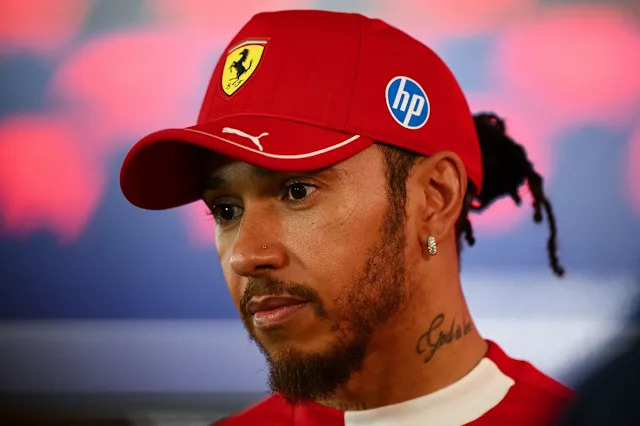
Lewis Hamilton's China podium has unlocked a version of the seven-time world champion the paddock has not heard since early 2023 — reflective, unusually direct, and willing to push back against the commentators who spent 2025 declaring his best days finished.
Speaking in a post-race Ferrari interview, Hamilton tried to re-frame what his switch from Mercedes actually involves. "It's a huge difference and it's a huge undertaking," he said. "I think people for sure when they watch they will not understand how big it is when you move to a new team. You can arrive and jump into a cockpit, but learning the new tools, particularly a different culture and a different way that people like to work, and adopting that into the way you like to work."
That, for him, is the invisible work. The visible work was a podium — his first in Ferrari red — with his mother in attendance, and the deeply personal context that framed it.
"I had the sprint race last year which was amazing and my dad was there," Hamilton recalled. "Then to bring my mom to China and then have this amazing week with her and then have my first podium was very, very — it made it incredibly special, the whole experience. I've been trying to get that podium for a long time. It felt like never had to work so hard as to get a podium."
For a driver whose podium ledger numbers in the hundreds, that sentence is not a throwaway. It is a statement about how much harder a 2026 Ferrari is to extract than a mid-2010s Mercedes, and how much more meaningful a result becomes when it has been earned the hard way.
Hamilton gave explicit credit to the mechanics and engineers inside the Ferrari garage. "The team have been amazing for the past year, particularly in the garage. The support has been immense," he said. "Every weekend I fell short last year and I'd come back and you feel gutted and you feel bad that you've ultimately not been able to deliver for the team. But they're always like, 'Next time, next time.' And they're always just so positive and supportive."
Then came the pointed moment. Asked about the external narrative around him, Hamilton did not duck it. "When you have difficult years there's lots of questions all over the place," he said. "I saw some of the certain individuals that hadn't had anywhere near the success that I'd had just talking negatively, as they continue to do so today. And it felt great to be able to come back and come into this season and start off strong, to be able to show that I still have what it takes to compete at the front. I'll continue to try and show up and deliver in that way."
The jab will have its audience. Pundits who spent 2025 questioning Hamilton's motivation have, noticeably, changed their tone since Shanghai.
On the 2026 cars themselves, Hamilton was more positive than the wider paddock narrative. "It's really nice that we've started the season that we don't have bouncing, because obviously that last generation was a nightmare for everyone with bouncing apart from maybe the Red Bulls," he said. "That's one thing out of the way and it comes then back down to just pure car performance."
He was clear-eyed about Mercedes still holding the straight-line advantage. "I don't know how close we can close the gap this week. We've not brought upgrades in order to do so. So Mercedes will probably still be rapid on the straights, but there's less SM zones, so hopefully that means we can be closer."
The broader picture is a Hamilton who is publicly at peace with the scale of the Ferrari challenge — and a little less at peace with the people who suggested he should not have taken it on.