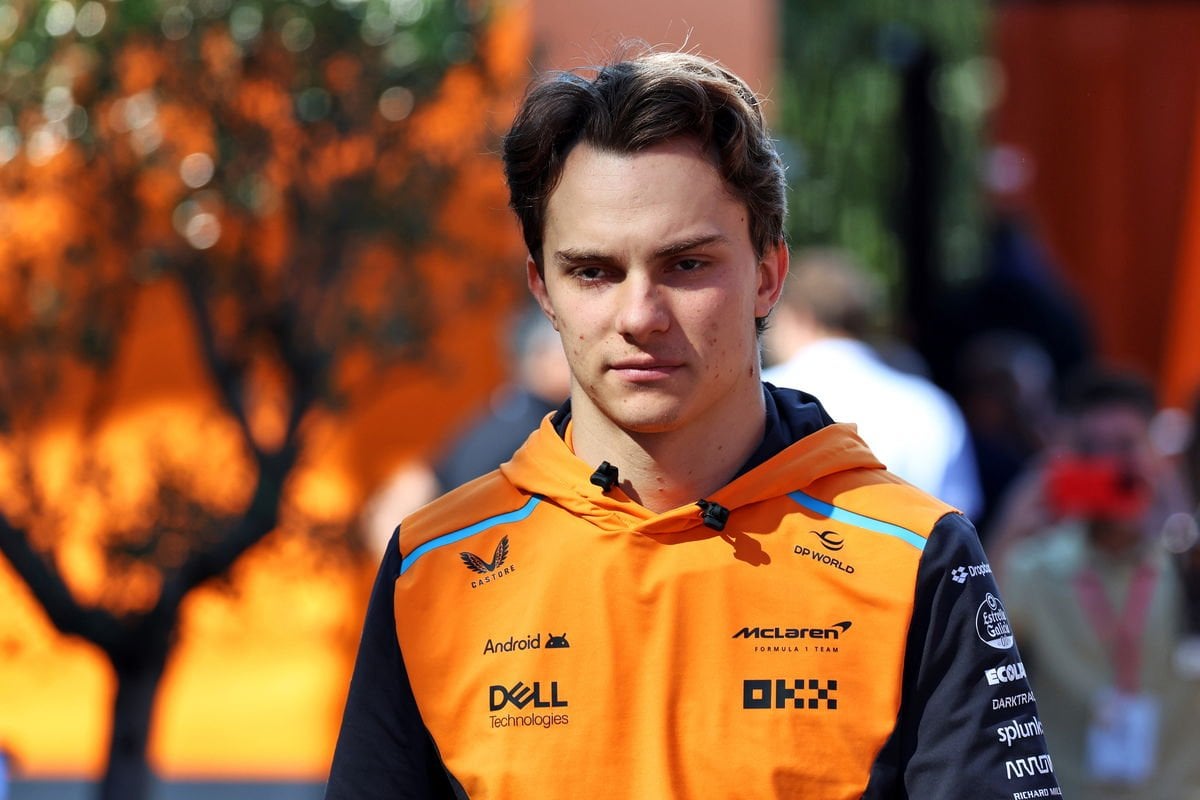
Oscar Piastri's Suzuka weekend ended on the podium. On paper, that is what a McLaren engineer would script. The problem, as Piastri himself acknowledged in two strikingly honest post-race answers, is that the paper does not show the whole story.
The McLaren driver framed the weekend in two consecutive sentences that will matter for the rest of the 2026 championship debate. "I think we just nailed everything," he said. "Unfortunately, it wasn't quite enough for the win, but I think at the moment a result like today is as good as a win for us." And then: "We did everything right this weekend and we still got beaten by 15 seconds."
The phrase is the uncomfortable one. Piastri does not sugarcoat it. Fifteen seconds is almost three tenths per lap across a 53-lap race. Against the car of the moment, Kimi Antonelli's Mercedes, McLaren — on Piastri's own diagnostic — did not make a mistake. The deficit is simply real.
He is equally clear about the shape of the fix. "I'm confident that we can get there," he said. "But yeah, we've still got some work to do."
Piastri's broader point, offered when asked whether Mercedes is actually beatable in 2026, was the kind of answer McLaren's senior engineers will have paused on. "We knew from last year — or we know from last year — that even when you have the best car, you still need to operate it at an incredibly high level," Piastri said. "And I think today on our side we did a really good job of that. But it's interesting to see, when someone else has the fastest car, that it's not that straightforward."
That is a coded sentence. For most of 2025, McLaren had the fastest car, and the pressure was on McLaren to execute. In 2026, the fastest car wears Mercedes silver. Piastri is arguing that the burden of operational perfection has shifted — and that whenever Mercedes does not clear that bar, the field narrows.
Suzuka itself, as it turned out, contained exactly that kind of Mercedes imperfection. Toto Wolff admitted to a software bug that gave Russell a "super clip" when the team had been trying to hand him an energy advantage. Mercedes's race starts were described, by Wolff again, as "mediocre". The winning car needed a piece of safety-car timing, on the team's own admission, for its final gap to grow. Mercedes was still good enough, on that less-than-perfect day, to beat McLaren by 15 seconds.
Piastri's own qualifying day had hinted at the same theme from a different direction. Asked about his failed final Q3 attempt, he offered a line that defined the 2026 driving experience in ten words. "Especially with these cars, it's very easy to think you're going faster and doing the right thing and you end up going slower because the engine doesn't like it." His final Q3 lap, he said, was one where "I just tried too hard. Yeah, tried to push a bit much and the rear end said no a few times."
That mismatch — between what a driver feels is fast and what the power unit actually rewards — is the single hardest operational challenge McLaren faces right now. A podium earned by staying inside the engine's preferred deployment window is, inherently, a podium that has been delivered with restraint. Piastri's inability to match Antonelli's race pace over a full stint is as much a deployment-strategy problem as it is a straight-line-speed one.
The upside is that McLaren's year is only three races old. Andrea Stella's pre-Suzuka argument — that the MCL40 is a "high potential platform" currently under-exploiting its Mercedes power unit — is now sitting next to a specific number. Close 15 seconds over a 53-lap race, and McLaren is fighting for victories. Lose another three or four race weekends at the same pace, and the championship picture is functionally over.
For Piastri personally, the most interesting admission of the weekend was almost a throwaway.
"The fact that we could have such a strong result, even though we know we're still lacking in many areas, for us to still finish second and fifth, I think is a positive thing," he said of McLaren's combined Suzuka points haul.
"Second and fifth" is the spine of McLaren's current season. It is not a winning spine. It is a trajectory spine. The Australian's honesty about the 15-second gap is what turns that trajectory into a measurable target.