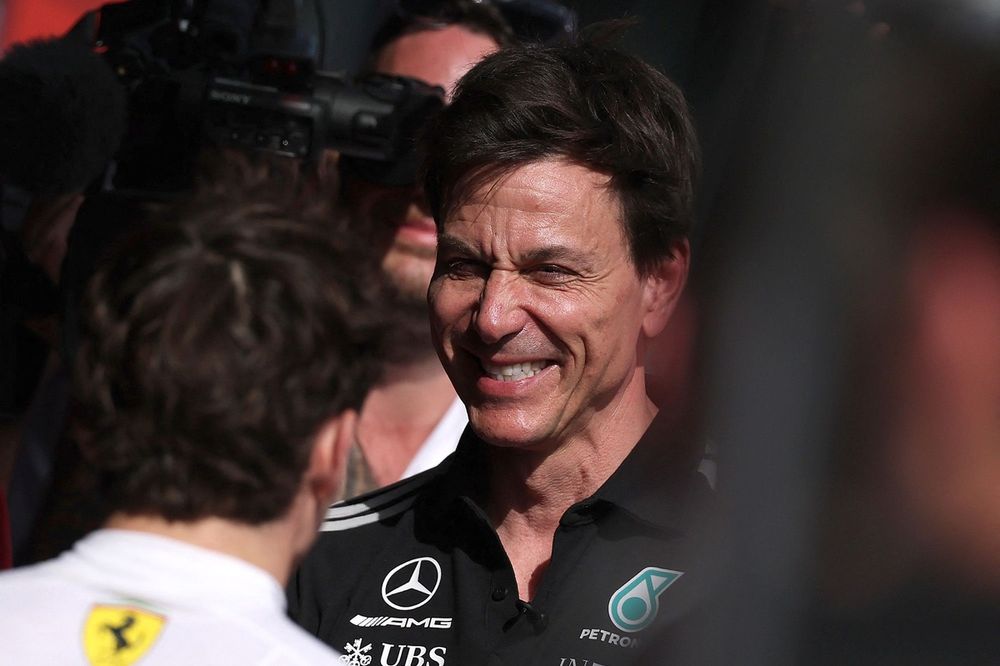
The most interesting piece of Mercedes insight to emerge from Suzuka came from Toto Wolff, speaking after the Japanese Grand Prix about why George Russell had quietly dropped a position during the race without an obvious televised reason. Wolff's answer was specific, technical, and almost disarmingly blunt.
"It was a bug in the electric system in the software that we thought we're going to give him an advantage by deploying energy," Wolff said. "And what it gave him is a super clip. It means it slows the car down, and this is why I unexpectedly lost the position to look. So we haven't covered ourself in glory when it comes to George's race as well."
For the paddock — and for the fans who spent much of the race wondering what the problem was — that is a genuine moment of disclosure. In an era when team principals are increasingly careful to keep the technical story vague, Wolff named the specific failure and took direct ownership of it.
The shape of the problem tells the story of the 2026 regulations in miniature. The new 50:50 combustion-to-electrical power split means a car's behaviour on any given straight depends less on throttle input and more on what the software is choosing to do with battery deployment. Done well, deployment gives a driver an invisible extra push. Done badly — or written badly — it can "clip" the car: starve it of electrical power at the moment it needs the most.
Wolff described the bug as attempting to deliver the first scenario and producing the second. The intended deployment advantage became a "super clip" — more severe than a routine clipping event, because it was triggered deliberately rather than arriving at the end of a deployment window.
This is the inside-out version of Norris and Verstappen's recurring public critique of the 2026 regulations. Norris has said the sound of the engine note dying mid-straight "hurts your soul". Wolff has now admitted his team generated that exact symptom on one of its own cars — by accident — while trying to go faster.
The context cushions the embarrassment for Mercedes. The winning car, Kimi Antonelli's, had no such problem. Antonelli converted his second consecutive pole position into his second consecutive victory. Russell's power-clip moment cost him a place but not the race. For a team that has otherwise looked like the untouchable benchmark of the early 2026 season, a single software slip does not dent the standings.
What it does do is remind rivals that Mercedes is not immune. The next question, inevitably, is whether the same category of bug could occur again, and whether the fix will be quick and quiet or slow and visible. Wolff did not volunteer a timeline. In the debrief, McLaren, Ferrari, Red Bull and Aston Martin will all have seen a window — a moment when the strongest car on the grid was running on code that did the opposite of what it was told to do.
Russell, for his part, had already spent the weekend dealing with a different problem. His Saturday had been built around a "tiny" setup adjustment made before qualifying that left him feeling like "something simple was broken" on the rear of the car. A front-row start was more than he had expected. Losing track position to a software bug on Sunday, after salvaging a grid slot from a mechanical scare on Saturday, made for an unusually rough weekend for a driver whose team looks dominant on paper.
Wolff's willingness to say all of this out loud is a data point in itself. It fits a pattern — more visible over the past season — of a Mercedes team principal leaning into ownership of specific technical failures rather than deflecting. In 2026, with teams understanding less about their own cars week-to-week than they have in a decade, honesty is the easiest narrative to keep consistent.
"We haven't covered ourselves in glory," Wolff repeated. It was a sentence that made both George Russell's Sunday — and Mercedes' lead of the championship — feel a lot more fragile than the final positions suggested.