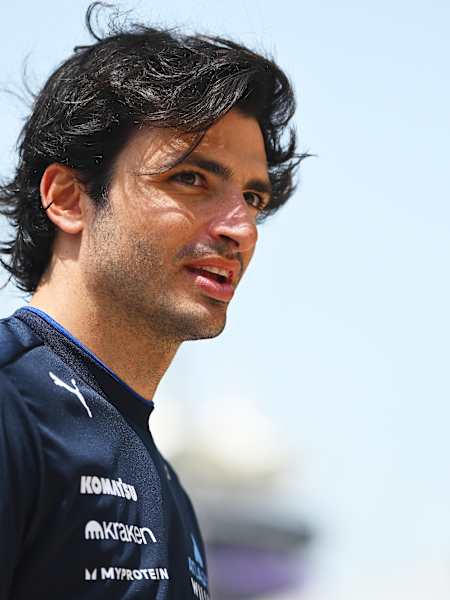
Carlos Sainz spent the Miami Grand Prix being pushed around by Max Verstappen and the post-race day arguing about a stewarding system he believes is becoming the biggest problem in Formula 1.
The Williams driver, also a director of the Grand Prix Drivers' Association, was forced wide at turn 17 by Verstappen's recovering Red Bull. The stewards noted the incident and waved it through as a racing matter. Sainz's reaction on team radio captured exactly the frustration that has been building in the senior end of the grid.
"He pushed me off. He thinks he can do whatever he wants just because he's racing in the midfield," Sainz said.
Asked about the move after the race, Sainz stood by every word. He acknowledged it was within the limits of what hard racing now looks like, but described it as borderline and "too aggressive". The deeper grievance, the one he has been carrying through the entire 2026 season, is structural.
For months, Sainz has been the loudest voice on the grid pushing for fixed permanent stewards. The rotating panels that change every weekend, in his view, are no longer compatible with the complexity of modern penalty rulings. Miami became his case in point.
The Verstappen pit-exit-line penalty, a call that should have been adjudicated in seconds, was held back by the panel for hours because the stewards said live camera footage was not clear enough. Leclerc's 20-second penalty for cutting four corners with a broken Ferrari, set against Hamilton's lighter penalty for similar offences in Singapore, completed the picture. The same rules, the same season, the same teams; very different outcomes depending on who was in the steward's room.
Verstappen's own response to Sainz's outburst was the kind of line that will sit awkwardly with the GPDA. Asked about pushing Sainz wide, the Dutchman did not engage with the substance.
"It's a bit of a jungle in the midfield," Verstappen said.
That was it. Nothing else. The Miami stewarding panel that found his pit-exit-line tyre crossing worth five seconds also found his contact with Sainz worth nothing.
The 2026 reforms to the International Sporting Code were supposed to head off exactly this kind of public complaint. The FIA expanded post-race review options, set up an off-site stewards' panel for video calls, allowed stewards to review their own decisions, and tightened the rules around penalty points. All of those reforms were live in Miami when the same panel that needed hours to confirm a tyre over a white line cleared multiple on-track contacts within minutes.
Sainz has not framed his case as a personal dispute with Verstappen. His focus on permanent stewards predates Miami and predates 2026. But the run of incidents at the Hard Rock Stadium track will inevitably push the conversation forward when the GPDA next meets in Canada. With Liam Lawson's gearbox failure sending Pierre Gasly's Alpine into a barrel-roll, with Hamilton and Franco Colapinto colliding at turn 11, and with Verstappen and George Russell tangling at the final corner of the last lap, only two penalties came out of the entire weekend. None for the contacts that nearly ended races.
The FIA has consistently rejected the idea that rotating panels are part of the problem. Miami may be the moment that argument runs out of road.
"He thinks he can do whatever he wants," Sainz said. He is no longer sure the system the FIA designed has any way of telling him otherwise.