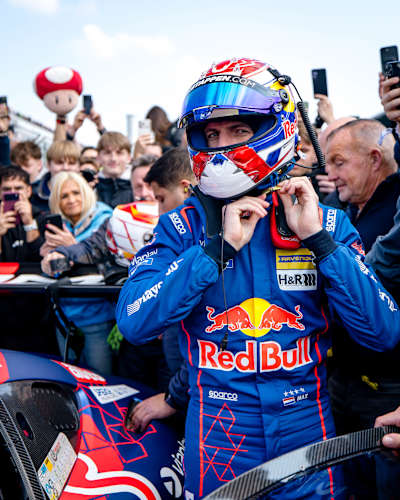
Albert Park gave Max Verstappen one of those weekends a champion politely refuses to enjoy. The four-time world champion was singled out by broadcasters and pundits for his recovery overtakes through the closing stages. He chose, immediately, to puncture the narrative.
Verstappen dismissed the praise. He explained that while overtakes are fun, he did not particularly enjoy these ones since he was racing cars two seconds slower. He viewed it as simply clearing traffic rather than fair racing, and described his overtakes as not being a fair fight. The framing was unmistakable. He is not interested in highlight-reel passes against cars he is laps faster than. The version of Formula 1 that excited him is the one where the leader can be hunted.
He was also unusually transparent about why Red Bull's race did not look like a championship contender's. Verstappen explained that Red Bull suffered from significant tyre graining issues, particularly with the hard compound they chose, which compromised their race performance. The hards became the wrong call almost immediately, and on a track where strategy was already narrow because of safety-car risk, that left him with no realistic path back to a podium even before he started passing midfield cars.
The more important comments concerned Mercedes. Verstappen said he believes Mercedes will be quick everywhere, not just at the Australian Grand Prix circuit, suggesting they have a fundamental car advantage. That is a significant prediction from a driver whose entire reading of pace is calibrated by years of comparing his own machinery to the field. He is not framing the Mercedes' advantage as track-specific. He is calling it a structural lead that he expects to persist across very different layouts.
His read on McLaren was more cautious. He expressed uncertainty about Red Bull's pace relative to McLaren, noting that McLaren had appeared faster in Bahrain and that performance would vary track by track. That is the qualifier that has aged the worst of his post-Albert Park comments. McLaren has spent the weeks since wrestling with battery problems and reliability issues that have erased the Bahrain margin. But in the moment, with Bahrain testing fresh in the data, the assessment was reasonable.
What he refused to do, in a race that produced no podium and no front-running pace, was concede the championship. Verstappen stated that it does not matter if Red Bull are third or fourth fastest because they are aiming for the top, though he acknowledged they currently have a decent gap to close. It is the same Verstappen who has always treated finishing positions inside the top three as a baseline rather than a result. The gap to Mercedes is real, the tyre graining is fixable, and the McLaren question is open. None of those, he made clear, are reasons to back off.
There was a second, less obvious tell in his comments. He has begun to speak about Mercedes the way he used to speak about Ferrari in the years they were the threat. That is, with respect rather than dismissal. The 2026 regulations were supposed to compress the field. From Verstappen's seat, Albert Park did the opposite. Mercedes, in his words, have a fundamental advantage. Beating that, more than the tyre graining or the McLaren read, is the problem he has set himself for the season.