For a brief period during the Nissan era in Formula E, commentators kept returning to the same observation. Something was different about the Nissan down the straights. The car looked and sounded the same. The timing-screen deltas to the rest of the grid did not.
The engineer responsible for that, Dr Chris Vag, has now walked viewers through the full story in a feature released on Scott Mansell's Driver61 YouTube channel. In roughly fifty minutes of interview, Vag lays out the philosophy behind the car and — without handing away the full technical blueprint — explains why the governing body eventually wrote new regulations specifically to stop it.
"To find that special idea that you think nobody else has seen," Vag told Driver61, "that reads between the lines, that sits slightly in that area where it's legal but it's not obvious, and you think that nobody else is going to have seen this — actually, you freeze time."
That line, delivered without any visible attempt at drama, captures the engineering mindset that produced the project. Vag's starting point was not an incremental improvement. It was an ambition that would read as absurd in most paddocks.
"The starting point was what would it take to get a second per lap of performance," he said, "or even better, to be able to lap every other car on the circuit and be the only people on the final lap of the race."
In a spec-series context, where the car architecture is largely fixed by the governing body, a second a lap is not a goal — it is a gauntlet. Vag approached it the only way an engineer can in a locked-down rule environment. He went back to the fundamental limits.
"One is energy and the other one's power," he explained. "So both are limited by the regulations. You've got a maximum amount of energy that you can deploy in the race, and you've got a maximum amount of power that you can deploy at any point in time. And to be able to exceed those — even temporarily — would provide massive advantages."

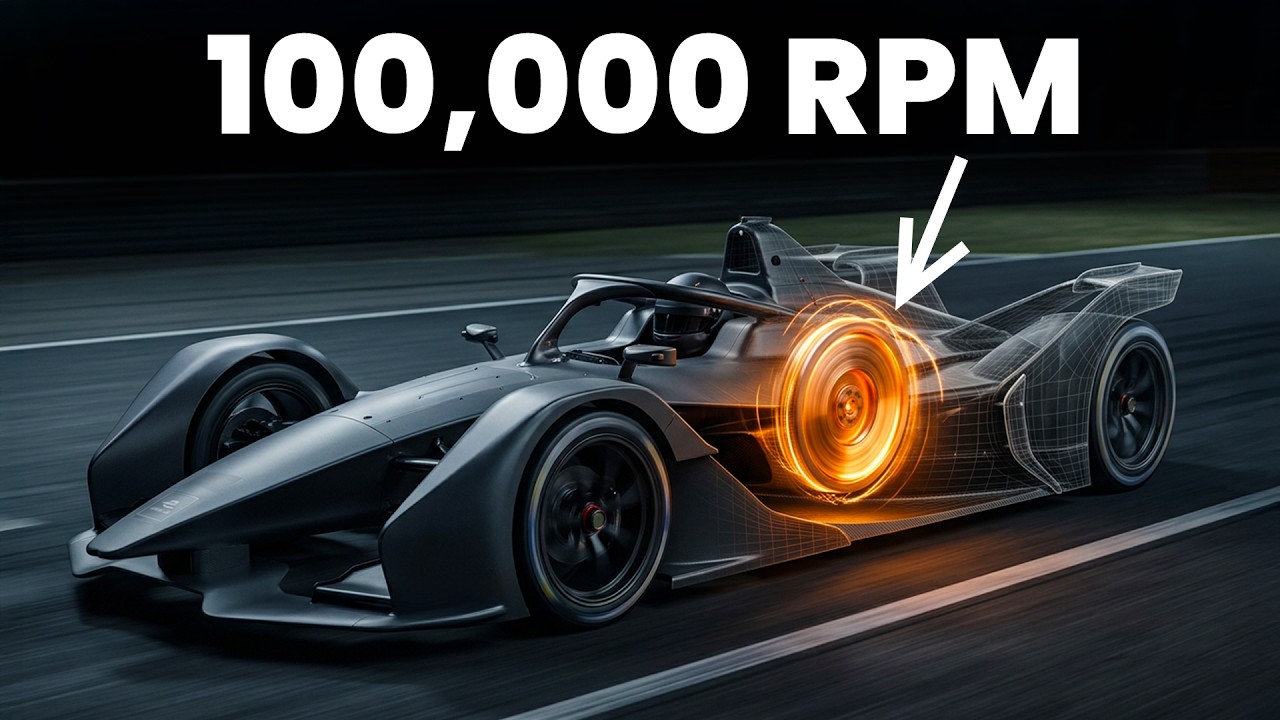
The rulebook defined the upper bound on both. Where Vag saw an opening was in how energy was stored and converted before it reached the motor. The mainstream assumption in Formula E was that energy storage meant a battery. Vag treated that assumption as a choice rather than a law of physics.
"I explored a whole range of different options," he said. "Thinking about how else can we store energy on the car and how else could we deliver that to the wheels, and looked through all of the different types of energy storage that exist physically."
Kinetic storage. Potential storage. Chemical alternatives. The interview walks methodically through the categories Vag worked through, without giving rivals a walk-up blueprint of the final solution. What is crystal clear is that the eventual answer was not a tweak to the existing battery — it was an architectural rethink about how stored energy could be moved to the driven wheels within the legal envelope.
The car, once deployed, produced results almost immediately. Qualifying form was strong. Race form was stronger.
"It started to become quite clear that we were going to dominate qualifying throughout," Vag said. "And it also started to become clear that the race pace was going to be a dominating factor as well."
Rival teams were not slow to notice — only slow to diagnose the cause. One paddock observer captured on Driver61's archive footage put it simply. "The Nissan on the straight is on a different planet. Don't know what it is, but it's really strange."
The sport's governing body reacted in the way regulators usually react when a team finds an answer the rule book did not anticipate. The regulations were rewritten at the next available cycle, closing the architectural door Vag had walked through.
Driver61's framing of the episode is less about celebrating a specific loophole than about what it reveals about motorsport engineering in general. Rule books are not closed documents. They are written by committees who cannot foresee every combination of ideas. That leaves work — sometimes enormous, sometimes career-defining work — for engineers who are willing to read between the lines and treat the assumed landscape as optional.
The parallels with the current Formula 1 debate over 2026 rules — yo-yo racing, harvest limits, state-of-charge penalties — are not perfect, but they are close enough to be instructive. The F1 rulebook is locked in for at least four seasons. The teams that win will be the ones willing to challenge what that rulebook assumes rather than what it explicitly forbids.
Vag's Nissan is a reminder that this has always been how motorsport moves forward. The trophies, and occasionally the bans, are the receipts.