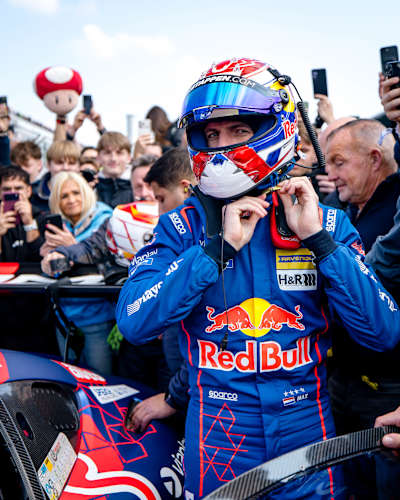
Miami didn't just reshape the 2026 pecking order — it produced a regulatory grey area that the FIA has been forced to publicly defend. Red Bull's upgraded RB22 included a sidepod-to-floor junction unlike anything on the grid, and McLaren team principal Andrea Stella has been the first major figure to put a name on what is happening.
The Miami floor and bodywork package brought Red Bull back into the top-four conversation in a single weekend. The team that had spent China and Japan flirting with the midfield suddenly had Max Verstappen on the pole margin and capable of fighting for the podium. A first-lap spin denied him the result, but the underlying picture was unmistakable. The car was a different animal.
Visually, the upgrade added a substantial dive plane to the front wing and rotated the rear wing into an upside-down form. The bigger story sat further back. A full floor revision, a new sidepod inlet, a higher-walled engine cover and a wide waterslide design signalled a wholesale concept change. The detail that has the rest of the paddock studying photographs is the rear corner of the sidepod, where it meets the floor.

That junction now carries a sharp fence rather than the smooth, curved transition required everywhere else on the car. Stella did not hide his interest. Red Bull, he told The Race, has been 'quite smart and innovative' in exploiting what he called 'legality concessions' to introduce a shape that, by the conventional reading of the rule book, should not have been possible.
The rules behind this are intricate. Sidepod bodywork sits under different reference volumes at the front and back — the side inlet reference volume governs the front, the engine cover governs the back, and both demand smoothly curved surfaces with minimum radii. The intention is to stop teams growing aerodynamic fins along the sidepod for safety reasons. But the area where the sidepod meets the floor is technically part of the floor corner, where those geometric demands do not apply.
Red Bull's design splits the bodywork so that the back of the sidepod is treated not as engine-cover bodywork but as a multi-section floor corner. When two such sections are trimmed and joined, the internal boundary is not in contact with the external airstream — and therefore, by the regulations' definition, is not an aerodynamic surface. The minimum radius requirement does not bite. The sharp edge is legal.
The FIA has cleared the design as a clever interpretation but has flagged it for monitoring. If other teams try to copy the trick — or if the configuration contributes to a more turbulent wake — the governing body has signalled it may rewrite the wording for 2027 and beyond.

The expected aerodynamic purpose is a sealed-floor strategy. The sharp edge appears positioned to create a vortex at the outboard rear corner of the floor, with the slotted floor edge feeding energised air inboard of that vortex. Together they form a barrier between clean underfloor flow and the dirty wake coming off the rear tyre. The payoff would be higher and more stable underfloor pressure, which is exactly what the early-season RB22 lacked.
Isack Hadjar had described the car's pre-Miami behaviour as forcing him to guess what would happen each session, and Verstappen had said the chassis swung between understeer and oversteer extremes. The Miami package was built around rear stability, and the sidepod-to-floor sealing fits that brief.
Stella's comments carry an implication that Red Bull's rivals will take seriously: the trick may be replicable, but only as part of a bigger conceptual rewrite. For teams already locked into 2026 development paths, copying the idea cleanly may be a 2027 conversation — by which point the FIA may have closed the door.