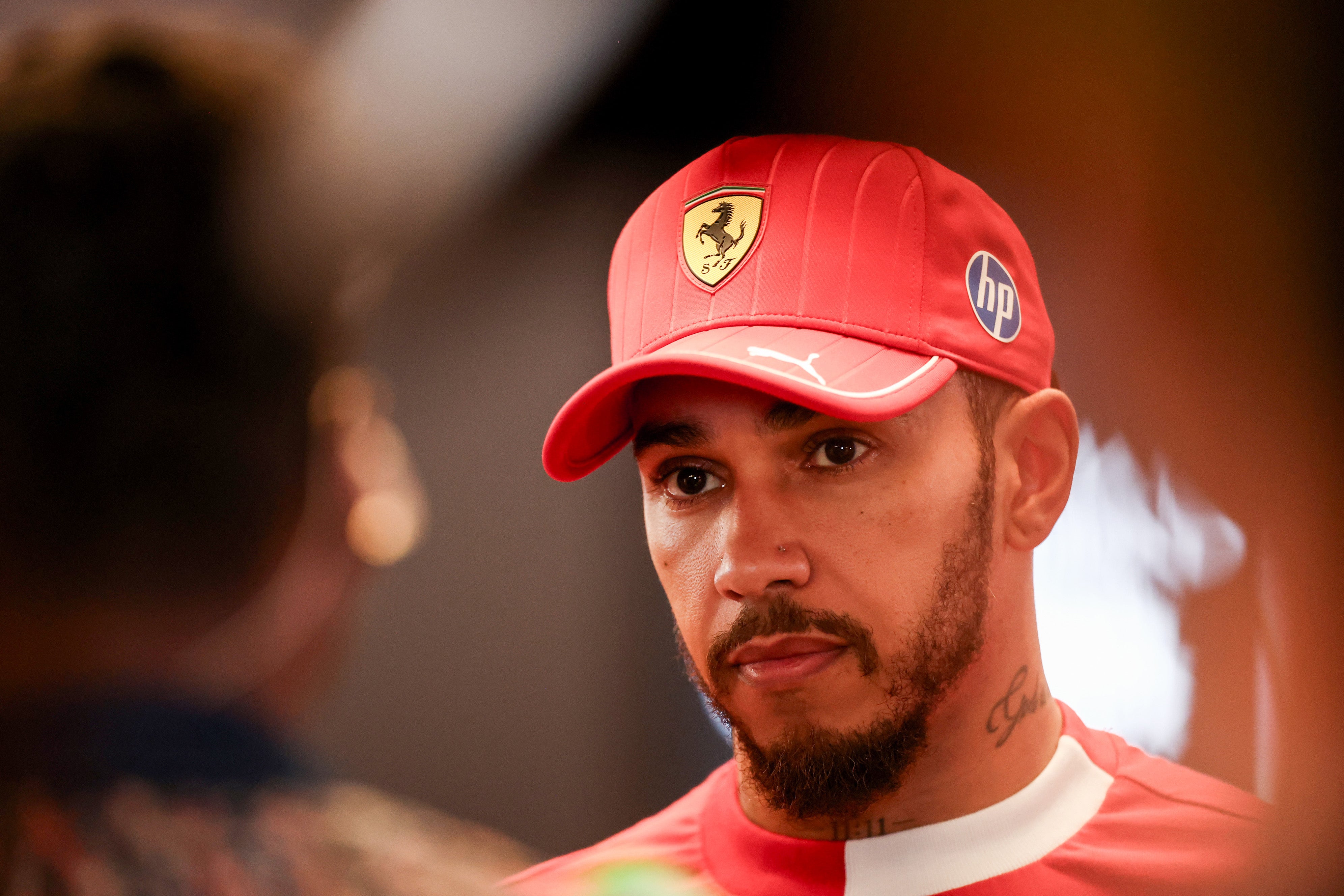
Lewis Hamilton's Miami Grand Prix is starting to look very different on a second viewing. The race that supplied the cult radio moments of the weekend — "have a tea break while you're at it" — was, on the technical evidence, less a meltdown than the rolling consequence of a tiny Lap 1 collision that quietly broke the SF-26 in two directions at once.
Hamilton finished sixth, an inherited result after late penalties shuffled the order, and Ferrari has not publicly explained the gap to Charles Leclerc in race pace. That gap is now being explained, exhaustively, in independent technical analysis published this week by Scuderia Fans, which laid the entire weekend at the feet of a barely-noticed first-lap contact with Franco Colapinto.
"This is exactly what happened to Lewis Hamilton during the race, when he lost all of his side deflectors following a first-lap contact with Franco Colapinto," the analysis read, "resulting in an immediate loss of approximately 20 points of downforce from his Ferrari SF-26."
The more troubling part of the data, though, is the gap between the raw downforce figure and the lap-time penalty Hamilton actually suffered. "The overall performance impact in such situations has been estimated at close to half a second per lap, which is significantly greater than what would be expected from a simple 20-point downforce reduction," the analysis continued. The reason is asymmetry. "Only the left-side deflectors were lost in the incident. This effectively created an imbalance in how the car behaves in left-hand versus right-hand corners."
That asymmetric damage profile explains why Hamilton's race looked, from the outside, like a driver running out of patience with his own engineers. Stretches of the second stint were spent asking race engineer Riccardo Adami for race-pace information he could not realistically use, and the radio eventually frayed.
"Have a tea break while you're at it, come on!" Hamilton snapped during one drawn-out exchange. Earlier, when told to hold position behind a slower car, he had asked: "Do you want to let him by too?"
In the post-race interviews, Hamilton refused to apologise for the tone, while distancing himself from the suggestion that he had lost his temper. "It wasn't even anger. It wasn't like, effing and blinding and anything like that," he said. "I'm not going to apologize for being a fighter. I'm not going to apologize for still wanting it."

The seven-time champion was insistent that the radio was a window into the racing driver, not the man. "I've still got my fire in my belly," he said. "I could feel a bit of it really coming up there. I want to win."
He also defended Fred Vasseur, who reportedly came to his hotel room after the race. "You've got to understand we're under a huge amount of pressure within the car," Hamilton said. "Fred came to my room. I just put my hand on his shoulder and like, 'Dude, calm down, don't be so sensitive.'"
For all the noise, Hamilton's belief in the underlying car remains stable. "I truly believe that when we fix some of the problems that we have with the car, we'll be back in the fight," he said.
The Miami damage will not affect Canada — the SF-26 chassis is structurally untouched, and replacement deflectors are an off-shelf component — but the broader concern for Ferrari is sensitivity. A car that loses half a second of pace from a single-corner first-lap tap is a car that depends very heavily on a clean race. Leclerc's 20-second penalty for his own Miami spin underlined the same point from the other side of the garage.

The SF-26 looks fast in a vacuum. It looks brittle when the racing turns physical. Canada, with its high-speed straights and 90-degree chicanes, will be the next stress test — and Hamilton, judging by Miami, will not be quiet about it.